By Shaheda Omar, Child Protection Practitioner
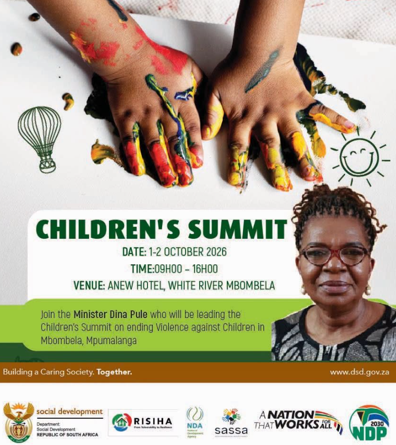
South Africa is very good at holding summits about children.
We gather experts. We invite children to speak. We issue commitments. We promise collaboration. We talk about strengthening systems, improving accountability and putting children’s voices at the centre.
And then the summit ends.
The banners come down. The speeches disappear into reports. Officials return to their departments.
But the children remain where they were — in homes where they may not be safe, schools where violence can go undetected, communities where exploitation thrives and digital spaces where predators can reach them from behind a screen.
So let us ask the question that matters:
After all the talking, will a child actually be safer?
Because South Africa does not have a shortage of concern about violence against children.
We have a shortage of consistent action, implementation and accountability.
We cannot keep congratulating ourselves for having laws
Our country has legislation and policies designed to protect children. We have institutions with mandates to intervene. We have professionals who work tirelessly to protect vulnerable children.
But a law sitting in a statute book does not protect a child.
A policy document does not comfort a terrified child at 2am.
A strategy does not remove an abusive adult from a home.
A referral form does not provide therapy.
And a promise does not prevent the next rape.
The true measure of our child-protection system is not what it says it will do.
It is what happens when a child actually needs it.
That is where the cracks become visible.
A child discloses abuse, and the system may require that child to tell their story repeatedly.
A family seeks help and discovers that services are overstretched.
A child needs specialised therapy but faces delays or limited access.
A case enters the justice system and a traumatised child waits.
Different departments hold different pieces of the child’s life, but the child is left trying to navigate the gaps between them.
This is not what protection should look like.
Children are speaking. Are we listening?
There is something profoundly important about placing children’s voices at the centre of the national conversation.
But we must be careful not to turn participation into performance.
We cannot ask children to tell us what frightens them, applaud their courage and then fail to change the conditions that made them afraid in the first place.
Children are not attending these conversations to give adults permission to do nothing.
They are telling us where the system is failing them.
They are telling us when they do not feel safe.
They are telling us when adults do not believe them.
They are telling us when reporting abuse becomes more frightening than remaining silent.
And they are telling us that violence does not exist in neat departmental categories.
For a child, it is all connected.
Home. School. Community. Police. Health services. Social development. Justice. Technology.
A child does not experience government in departments. A child experiences one life.
Our systems need to understand that.
The child should not have to become a statistic before we act
One of our greatest failures is that we continue to respond to children after the damage has been done.
We respond to the rape.
We respond to the abuse.
We respond to the suicide attempt.
We respond to the school dropout.
We respond to the crisis.
But where was the intervention before the crisis?
Where was the social worker?
Where was the early intervention?
Where was the family support?
Where was the school safeguarding mechanism?
Where was the community response?
Where was the adult who could have recognised the warning signs?
These are uncomfortable questions, but they are the questions a serious child-protection system must ask.
Prevention cannot remain an afterthought.
If we only mobilise once a child has suffered catastrophic harm, we are not preventing violence. We are managing its consequences.
And now the predator has entered the child’s bedroom
The internet has transformed the child-protection landscape.
A predator no longer needs to wait outside a school gate.
They can enter a child’s world through a phone.
Grooming can begin with friendship. Attention. Compliments. Games. Gifts. A seemingly harmless conversation.
Then the boundaries shift.
The secrecy begins.
The manipulation intensifies.
And eventually the child may find themselves trapped in a relationship they do not understand and do not know how to escape.
Artificial intelligence and digitally manipulated images have created further opportunities for exploitation.
Yet too often the response is to tell children to “be careful online”.
That is not enough.
We would never tell a child walking through a dangerous neighbourhood simply to “be careful” and then consider our responsibility fulfilled.
The same principle must apply online.
Children need digital literacy. Parents need knowledge. Schools need safeguarding protocols. Professionals need specialised training. Platforms need meaningful child-safety measures. Law enforcement needs the capacity to investigate digital exploitation.
And children need something else:
They need to know that if they make a mistake online, they can still come home.
If a child fears punishment more than they trust their parent or caregiver, they may remain silent.
Silence is exactly what predators exploit.
We must stop making children responsible for adult violence
There is another uncomfortable conversation we need to have.
Children cannot be responsible for ending violence against children.
Adults are.
We cannot tell children to speak up while failing to ensure that there is someone equipped to listen.
We cannot tell children to report abuse while leaving them frightened about what will happen after they report.
We cannot tell children to stay safe online while giving parents little guidance and leaving technology companies to police themselves.
We cannot tell children that their best interests come first while making them wait indefinitely for services.
And we cannot ask children to repeatedly demonstrate their resilience while failing to address the environments in which they are being harmed.
Resilience is not a substitute for protection.
The summit must now face the accountability test
The real test begins when the summit ends.
Every commitment must have an owner.
Every promise must have a deadline.
Every programme must have resources.
Every target must be measurable.
And every failure must have consequences.
We should not have to wait another year to ask whether anything changed.
Government should be able to tell the public:
How many vulnerable children received early intervention?
How quickly were reports responded to?
How many children received appropriate therapeutic services?
Where are the gaps in social-work capacity?
How many schools have effective safeguarding systems?
What has been done to address online grooming and exploitation?
How are children participating in monitoring the commitments made in their name?
And, most importantly:
Are children safer?
Not are we spending money.
Not are we holding meetings.
Not are we producing reports.
Are children safer?
That should be the national child-protection dashboard.
The professionals cannot keep carrying the system on their backs
We should also acknowledge the people doing this work every day.
Social workers, child-protection practitioners, educators, police officers, prosecutors, health professionals, NGOs and community workers are often carrying impossible caseloads and confronting horrific circumstances.
Many continue because they believe passionately in children.
But dedication cannot compensate forever for systemic weaknesses.
We cannot build child protection around the extraordinary sacrifice of individual professionals.
We need functioning systems.
We need properly resourced services.
We need multidisciplinary cooperation.
We need prevention.
We need accountability.
And we need political and administrative leadership that understands that child protection is not a peripheral social issue.
It is a measure of the health of the nation.
Do not ask children to wait for another summit
I want the children who spoke at this summit to be able to look back six months from now and say:
Something changed.
I was believed.
Someone came.
Someone listened.
Someone acted.
I was protected.
That is the outcome that matters.
Not the number of delegates.
Not the number of speeches.
Not the number of commitments announced.
Not the photographs.
The child.
For decades, South Africa has told its children that they have rights.
Now we must prove that those rights mean something when a child is frightened, abused, neglected, exploited or simply crying out for help.
We do not need another generation of children growing up knowing that adults held meetings about their safety while the systems meant to protect them failed to arrive.
The time for listening is not over.
But listening without action is no longer enough.
South Africa must move from conferences to consequences, from promises to implementation, from reaction to prevention — and from talking about protecting children to actually protecting them.
Because a child cannot live inside a promise.
A child needs protection in the real world.