MEDIA RELEASE
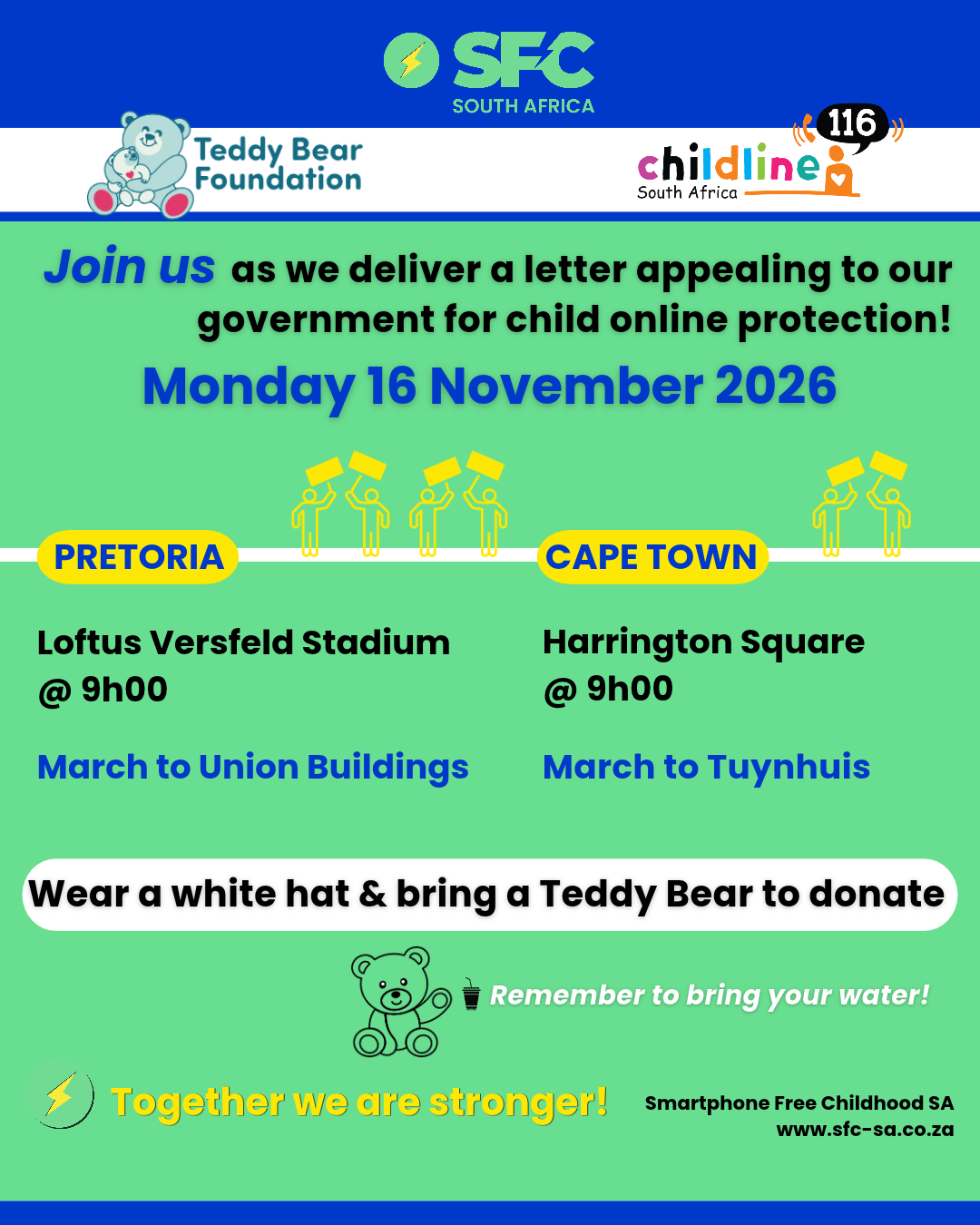
PRETORIA / JOHANNESBURG / CAPE TOWN, 13 November 2026 — A broad national coalition comprising leading South African child protection non-profits, mental health bodies, academic researchers, and legal experts has written a formal Open Letter to President Cyril Ramaphosa and key cabinet ministers, calling for urgent statutory intervention to safeguard children from social media and other harmful online platforms – to be hand delivered simultaneously to the Union Buildings (Pretoria) and Tuynhuys (Cape Town) on Monday 16 November 2026 at 10h30.
The Open Letter by Smartphone Free SA, Teddy Bear Foundation and Childline SA, addressed to the President alongside the Ministers of Communications & Digital Technologies, Basic Education, Social Development, and Women, Youth & Persons with Disabilities, highlights a severe public health and child protection crisis. The coalition warns that South African youth face an unregulated commercial digital ecosystem engineered to harvest data, maximise addictive engagement, and monetise attention without structural boundaries.
Core Evidence Highlighted in the Appeal:
– Adolescent Mental Health Crisis: Strong clinical correlations between intensive exposure to image-driven, comparative algorithms and rising rates of adolescent depression, anxiety, eating disorders, self-harm, and suicidal ideation – disproportionately impacting young girls.
– Exploitation & Online Harm: Unregulated access exposing children to cyberbullying, hate speech, predator grooming, and online sexual exploitation that parents cannot individually combat against profit-driven algorithms.
– Developmental Displacement: Passive screen consumption displacing sleep, physical activity, face-to-face social development, and classroom focus.
“Parents and educators are being forced to fight a losing battle against hyper-sophisticated, profit-driven algorithms. While early childhood screen guidelines are welcome, statutory protection cannot end at age six. Nor will digital literacy solve this enormous problem alone. We are appealing to our Government to establish enforceable legal boundaries that shift the burden of safety of children online from families and onto platform operators.” – Joint Statement by Signatory Organisations.
Five Strategic Appeals to National Leadership:
The coalition outlines a clear legal path under Section 28 of the Constitution (Child’s Best Interests) and the Children’s Act 38 of 2005, requesting immediate government action on five pillars:
– Statutory Age Limit (16+): Utilise the upcoming Audio and Audiovisual Content Services and Online Safety Bill to enact an enforceable minimum age of 16 for algorithm-driven social media account creation.
– Interdepartmental Task Team: Form a task team across DCDT, Basic Education, Health, Social Development, FPB, and the Information Regulator to draft a National Child Digital Wellbeing Framework.
– Platform Accountability and Safer Defaults: Mandate “safety-by-design” defaults for under-18s, prohibiting amongst others, targeted advertising, public discoverability, live-streaming to strangers, and addictive feedback loops.
– Privacy-Preserving Age Assurance: Enforce POPIA-compliant verification mechanisms that confirm age of user without storing or harvesting children’s biometric data.
– Smartphone-Free Schools: Issue national Department of Basic Education directives designating schools as smartphone-free zones during academic hours.
Connecting Local Action to National and Global Campaigns:
– The Manila Conference on Ending Violence Against Children: By taking decisive regulatory action, South Africa will align itself with the global commitments likely to emerge from the upcoming Manila Conference, demonstrating leadership in combating technology-facilitated violence against children.
– 16 days of Activism For No Violence Against Women and Children: The coalition emphasises that violence against women and children extends deep into digital environments. Protecting children is a cornerstone of ending gender-based violence and child exploitation in all forms. Young girls are disproportionately targeted by online harassment, self-esteem degradation, cyber-grooming and sexual coercion. Young boys are particularly vulnerable to online addictions including gaming, pornography and gambling.
– South Africa has an opportunity to join growing international momentum. Similar statutory age restrictions and platform duty laws have been enacted or passed in a number of countries including Australia, the United Kingdom, Indonesia, Malaysia, Brazil, China and Zimbabwe.
Media Contacts & Interview Enquiries:
Kate Farina
Smartphone Free Childhood SA
katefarina@sfc-sa.co.za
0828829189
sfc-sa.co.za
Dr Shaheda Omar
Teddy Bear Foundation
shahedao@ttbc.org.za
011 484 4554
teddybearfoundation.org.za
Dumisile Cele
Childline South Africa
dumisile@childlinesa.org.za
031 201 2059
childlinesa.org.za